
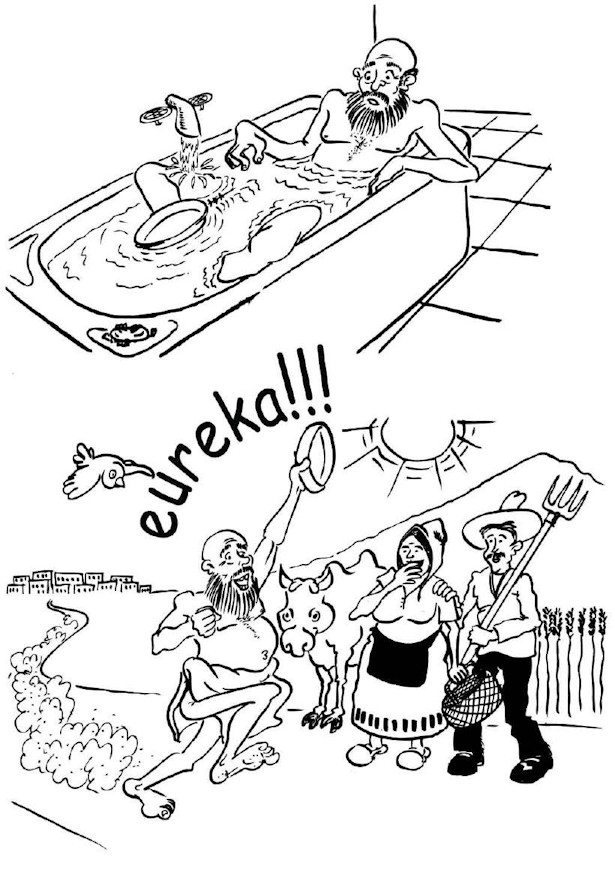
More than 2,000 years ago, a Greek scientist named Archimedes jumped out of his bath shouting “Eureka!” because he had just made a brilliant discovery about how things float and sink. His idea still explains why giant ships can stay afloat while tiny pebbles sink to the bottom.
In this activity, you will explore this very discovery for yourself. When you lower different objects into water, you will discover that the water pushes upward, almost as if it’s trying to lift them. You will see how this buoyant force depends on how much water is displaced – and by the end, you will understand the science behind floating boats, diving submarines, and even your favorite bath toys.
Science Involved
When an object is placed in water, the fluid around it exerts pressure in all directions. The pressure in a fluid increases with depth because the weight of the water above adds to the pressure below. As a result, the bottom of the object experiences a stronger upward push than the top, where the pressure is slightly less. This difference in pressure creates a net upward force on the object. This upward force is called the buoyant force.
The buoyant force acts against the object’s weight. If the upward force equals or is greater than the object’s weight, it will float; if it is smaller, the object will sink. So, the reason some things float while others sink is not about how heavy they are, but about how strongly the water pushes back in return which in turn depends on how much water they push aside.
Activity
Requirements
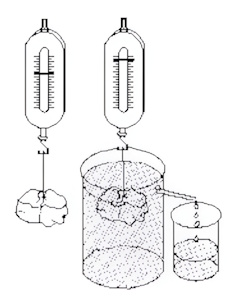
Measuring cylinder, overflow vessel, water, spring balance, 30 cm of thin thread, stone and a piece of wood.
Procedure
-
Tie the stone securely to one end of the thread.
-
Use the spring balance to measure the weight of the stone in air. Write this value in your notebook.
-
Fill the overflow vessel with water until it starts dripping out of the spout. Wait until it stops dripping.
-
Gently lower the stone into the overflow vessel so that it is completely submerged but not touching the bottom.
-
Collect all the water that overflows into the measuring cylinder. Measure and note the volume of the displaced water.
-
Measure the weight of the stone again while it is still submerged in water. Record this reading.
-
Repeat steps 1–6 with the piece of wood. (Note: The piece of wood will not be completely submerged in water.)
Observations
| Object | Weight of object when outside water | Weight of the object when immersed in water | Buoyant force acting on the object | Volume of water displaced (V) | Weight of water displaced |
|---|---|---|---|---|---|
| Stone | |||||
| Wood |
Reflect and Discuss
-
What is the relationship between the weight lost by the object and the weight of the liquid displaced by it?
-
What is the weight of the block of wood as shown by the spring balance when the block of wood is floating in water? Can you say that the block is weightless?
-
The wood floats but still displaces some water. How much water would it displace if it were forced to stay completely underwater? What will happen to the buoyant force acting on the wood in this case?
-
If two objects of the same size but different materials are completely submerged, will they displace the same amount of water? Why or why not?
-
The stone feels lighter in water – where does that “missing weight” go? Explain in terms of forces acting on the stone.
-
Archimedes’ principle is used to find the purity of gold in a crown. How do you think this experiment can help detect whether a crown is pure gold or mixed with another metal?
-
A beaker more than half full of water weighs 20 N. What will be the scale reading when:
-
a 5 N block of wood floats in it?
-
an 8 N block of wood floats in it?
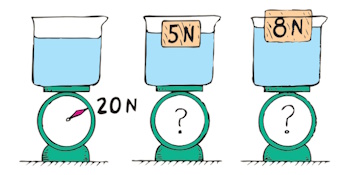 Image Credit: "Liquids". Conceptual Physics 12e, Pearson Education Limited. 2015.
 -
-
The same beaker when brimful of water weighs 30 N. What will the scale reading be, after the water overflows, when
-
a 5 N block of wood floats in it?
-
an 8 N block of wood floats in it?
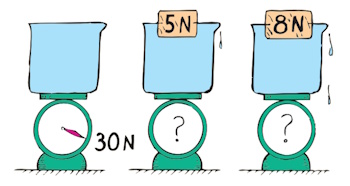 Image Credit: "Liquids". Conceptual Physics 12e, Pearson Education Limited. 2015.
 -
-
A 1 kg rock suspended above water weighs 10 N. When the rock is suspended beneath the surface of the water, the scale reads 8 N.
-
What is the buoyant force on the rock?
-
What is the scale reading when the rock is suspended beneath the surface of the water?
-
What is the scale reading when the rock is released and rests at the bottom of the container?
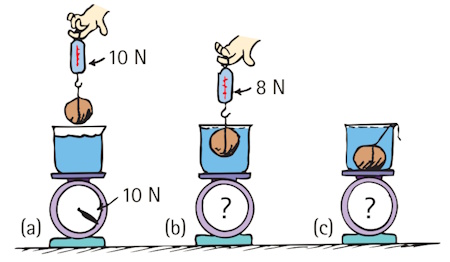 Image Credit: "Liquids". Conceptual Physics 12e, Pearson Education Limited. 2015.
 -
-
Imagine an ice cube floating in a glass of water. What will happen to the water level in the glass when the ice has completely melted?
-
Next image an ice cube of pure water floating in a glass containing salty water. What will happen to the water level in the glass when the ice has completely melted?