
dna sequencing
National Human Genome Research Institute, Public domain, via Wikimedia Commons.

DNA Sequencing

Genome sequencing is like solving one of the most intricate puzzles in the world, a puzzle made not of cardboard but of DNA. Every living organism, from the tiniest bacterium to human beings, carries a unique instruction manual written in a four-letter code: A, T, G, and C. Sequencing this code helps scientists understand what makes each organism unique, how traits are inherited, and even how certain diseases develop.

In this activity, you will take on the role of a genetic scientist and simulate the sequencing process. Instead of real DNA, you will work with fragments from a paragraph taken from the Harry Potter series. Your task is to arrange these fragments in the correct order to reveal the prophecy hidden within.

dna fingerprint
"What is a DNA Fingerprint?" LabXChange.

DNA Fingerprinting

DNA fingerprinting is a technique used to identify individuals based on unique patterns in their DNA. It is commonly used in forensic science, paternity testing, and genetic research. The process relies on cutting DNA at specific sites using restriction enzymes and separating the fragments by size using a process called gel electrophoresis.

In this activity, you will simulate the process of DNA fingerprinting using a printed DNA sequence and restriction enzymes. By following these steps, you will learn how DNA is cut, sorted, and analyzed to create a unique DNA fingerprint, just like scientists do in real-life forensics and genetics labs.

structure of dna
"The Structure and Function of DNA", Campbell - Essential Biology 7e.

DNA Extraction

All living organisms are made up of cells. Inside nearly every cell is a special code that makes every organism unique. The code is called DNA, or deoxyribonucleic acid, which is the hereditary material that carries the instructions for life and allows cells and organisms to function. Most DNA is located in the cell nucleus (nuclear DNA), while a smaller amount can also be found in mitochondria (mitochondrial DNA or mtDNA).

In this activity using a few simple materials, and some easy steps, you will extract DNA from cells and see the long, stringy fibers that carry the instructions of life.

turgor pressure in plants
LadyofHats, Public Domain, via Wikimedia Commons.

Osmosis in Potato Tissue

Potato cells contain water along with dissolved minerals and salts that help it stay firm and healthy. When a potato is placed in different surrounding solutions, water moves in or out of its cells depending on how concentrated those solutions are. This movement of water reveals important information about the internal environment of the potato.

In this activity, you will estimate the approximate concentration of the solution inside a potato using the process of osmosis. By placing potato strips in solutions of different concentrations and measuring how their mass changes, we can determine the point at which there is no net movement of water. That concentration will be closest to the natural salt and mineral concentration within the potato cells.

diffusion in agar cubes
CC BY-NC-SA 4.0 via biologycorner.com.

Cell Size and Diffusion

Why are living things, whether they are gigantic whales or tiny insects, all made up of cells that are incredibly small? Cells are always small; a whale doesn't have bigger cells than an ant – it just has a lot more of them.

For a cell to survive, it must constantly absorb essential nutrients and move them inside and simultaneously get rid of waste. But as cells grow bigger, it becomes harder for materials to move in and out efficiently.

In this activity, you will build model “cells” out of corn starch to explore how the size of a cell affects how quickly substances can diffuse inside it.

red cabbage indicator
Brunning, Andy. "Making a Red Cabbage pH Indicator". Compound Interest.

Natural Indicators

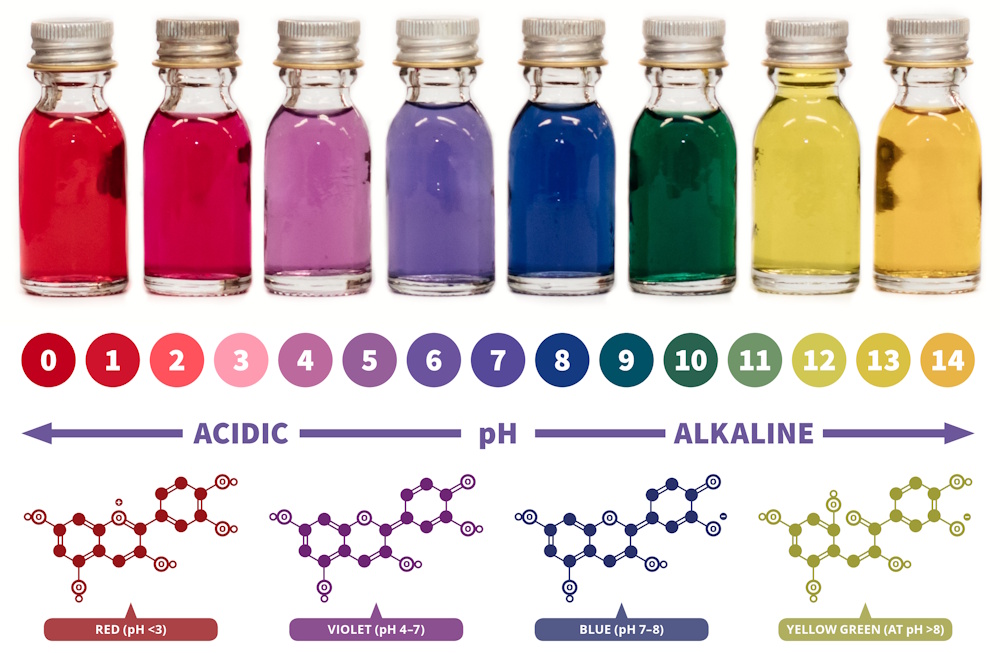
Have you ever noticed how a splash of lemon juice can change the color of certain foods? Or how turmeric stains become red when you add soap water? These color-changing reactions are not just kitchen surprises – they are tiny chemistry experiments!

In this activity, you will explore how natural materials like red cabbage, hibiscus, beetroot, and turmeric can reveal whether a substance is an acid or a base.

ph scale
Designed by Freepik.

Commonly used Laboratory Indicators

Certain food items like lemons, tamarind, and vinegar are sour to taste, while some substances like soap are slippery to touch and bitter in taste. It has been found that these items contain acids and bases. However, it is not safe to determine the nature of items by tasting or touching them. This is where indicators help us. Indicators are substances that change color in the presence of an acid or base, making it easier to identify their nature.

In this activity, you will explore some commonly used laboratory indicators and see how they help us identify the nature of different solutions.

titration
Bright, Dan. "How to teach Titration". Royal Society of Chemistry.

Neutralization

When your stomach feels uneasy after eating spicy food, what do you do? Many people take an antacid tablet. But did you know that when you do that, you’re actually performing a neutralization reaction inside your body?

Neutralization reactions have practical applications in daily life. From treating acidic soil on farms to making sure the water coming out of factories is safe for the environment.

In this activity, you will use two common laboratory chemicals – hydrochloric acid (HCl) and sodium hydroxide (NaOH) – to see how neutralization works. By measuring how much base is needed to completely neutralize the acid, you’ll also practice an important chemistry technique called titration.

Archimedes moving earth with lever

Exploring the Principle of a Lever

"Give me a lever long enough and a fulcrum on which to place it, and I shall move the world," declared the ancient Greek scientist Archimedes. He wasn’t exaggerating – he was revealing one of the most powerful ideas in science. Long before modern machines were invented, people used levers to lift stones, move logs, and build temples and pyramids. A lever is a simple tool, but it can do remarkable things – it lets you use a small force to move a large weight, just by changing how and where you apply that force.

In this activity, you will explore how levers work and discover for yourself how changing the position of the fulcrum, load, and effort can make lifting easier – just as Archimedes described thousands of years ago.

paper chromatography
In Grid Science: A Hands-on Science Education Resource.

Paper Chromatography

Chromatography is a fascinating scientific technique used to separate and analyze mixtures of substances. Many things around us, from the ink in our pens to the medicines we take, are actually made up of mixtures. Chromatography helps us “unlock” these mixtures, showing us their hidden components by separating them based on how they move through a material such as paper or gel.

In this activity, you will use paper chromatography to uncover the hidden pigments inside ordinary colored marker pens. By placing the ink on filter paper and letting water carry it upward, you will see how what looks like a single color is actually made up of several different dyes. Each pen will reveal its own unique “fingerprint” of colors, turning science into both an experiment and a work of art!